
The challenge: balancing demand, flexibility, and grid stability
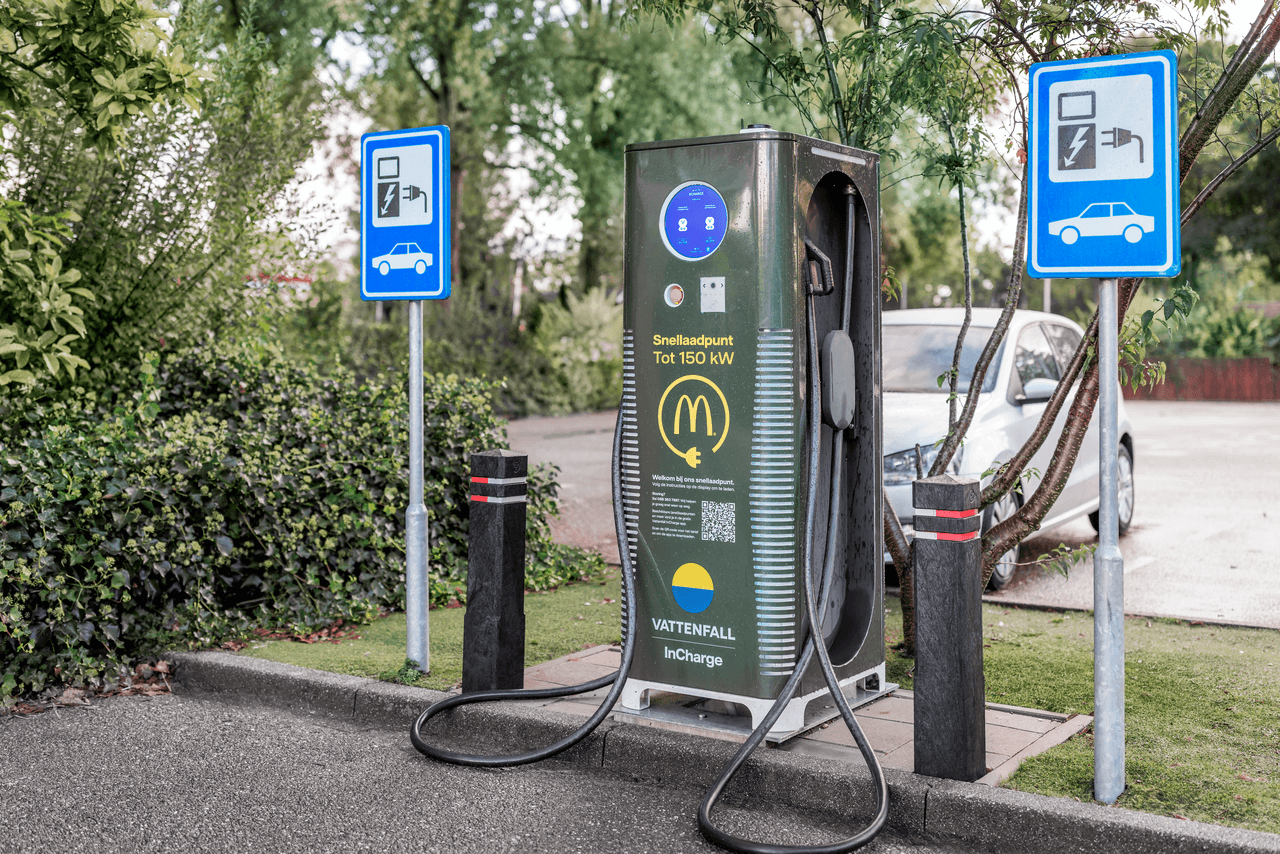
Across our E-mobility business, we operate thousands of charging points across multiple markets. At the same time, grid congestion, particularly during peak periods such as winter evenings, places increasing pressure on how and when energy can be delivered.
Today, charging typically starts immediately when a car is plugged in, regardless of when the energy is actually needed. In many cases, this leads to unnecessary peaks in demand and missed opportunities to better align charging with grid conditions.
To manage grid constraints, charging capacity may occasionally need to be reduced. While many sessions can absorb this, a meaningful share is impacted, potentially leading to incomplete charging and reduced revenue.
At the same time, EV charging flexibility represents a significant opportunity. If we can understand when a vehicle actually needs to be ready, we can shift charging to more optimal moments, thereby supporting grid stability while maintaining a good customer experience.
The key question becomes: how can we better understand and utilise this flexibility in real time?
Why AI has potential here
To unlock this flexibility, we need early insight into how long a charging session is expected to last and how much energy will be required.
The plug-out time prediction initiative focuses on generating these insights as soon as a session starts. By learning from historical charging patterns, AI models can estimate expected session end times and required charging volumes - even when no explicit input is provided by the driver.
This enables a shift from “charge immediately” to “charge when it makes most sense” and balancing user needs with grid conditions.
If sufficiently reliable, these predictions can support:
Shifting charging to periods that reduce grid congestion and better align with available capacity
Lowering the risk of incomplete charging by ensuring energy is delivered before the expected plug-out time
Capturing more value from flexible charging in electricity and balancing markets
Importantly, this is not about delaying charging arbitrarily, but about introducing flexibility where it already exists while maintaining trust and reliability for users.

How we approach AI projects
The plug-out time prediction initiative reflects a broader way of working within IT at Vattenfall: structured experimentation combined with clear evaluation criteria.
Rather than moving directly into production, we work in stages:
Data exploration and preparation from charging sessions
Model development and validation
Controlled proof-of-concept scenarios
Dry runs, where predictions are generated without influencing operations
This approach allows us to validate whether predictions are accurate, meaningful, and actionable before considering integration into operational systems.
Integration itself remains conditional and driven by demonstrated value rather than predefined assumptions.

Collaboration between business and IT
This initiative is built on close collaboration between E-mobility business experts and the AI Taskforce. This collaboration ensures that the problem definition reflects real operational challenges, that relevant data sources are identified and understood, and that model outputs are interpreted in a business context. It also ensures that any future solution aligns with operational workflows and constraints. By working together from the outset, we ensure that AI is developed as part of the business, not alongside it.
Opportunities and potential improvements
Although still in progress, the initiative highlights several areas of potential impact:
Smarter charging strategies that actively support grid stability during peak periods
Improved customer outcomes by reducing the likelihood of incomplete sessions
Increased ability to monetise flexibility in electricity and balancing markets
A stronger and more adaptive InCharge offering
At the same time, important questions remain:
How accurate can predictions be at an individual session level?
How should uncertainty and confidence levels be reflected in decision-making?
What is the most effective way to incorporate predictions into operational systems without adding unnecessary complexity?
These questions are part of the ongoing learning process and will shape future development.

Building AI capabilities through real use cases
Beyond this specific initiative, the work contributes to strengthening AI capabilities across Vattenfall. By applying AI to real operational challenges, teams gain practical experience in data handling, modelling, and integration. This helps us develop reusable patterns for applying AI in energy-related use cases, strengthens collaboration between IT and business domains, and builds a clearer understanding of where AI delivers measurable value in practice. At the same time, it reinforces our commitment to responsible and controlled adoption of AI.
Looking ahead
The plug-out time prediction initiative demonstrates how we explore AI at Vattenfall: starting from a real business challenge, validating potential through structured experimentation, and making decisions based on observed value.
As a work in progress, it represents a step towards more flexible, grid-aware energy solutions, where charging behaviour can adapt both to customer needs and to the realities of the energy system.
Through initiatives like this, we aim to better utilise flexibility, reduce grid stress, and contribute to a more resilient and efficient energy system.


Teaser
General BusinessContent Type
BlogPublish date
09/30/2026
Summary
Meet Athanasia“AI only becomes valuable when it solves real-world problems.” That belief has guided Athanasia Louloudi throughout more than a decade at Vattenfall. From technical specialist to l

Teaser
General BusinessContent Type
BlogPublish date
09/30/2026
Summary
PlaceholderVattenfall engineer Sonsoles Jimenez sees innovation as a collaborative process, where different perspectives, disciplines and expertise come together to solve challenges and prepare
.jpeg)
Teaser
General BusinessContent Type
BlogPublish date
09/30/2026
Summary
Meet TonyFor Vattenfall engineer Tony Sibo the switch between theory and practice creates a variety which makes his work unpredictable and interesting. It helps him see the way to a better tomor

Teaser
General BusinessContent Type
BlogPublish date
09/30/2026
Summary
PlacePhysical hydropower models, drones and digital twins. As the person responsible for model projects at Vattenfall’s laboratory, Pär Nilsen enjoys a varied working day filled with innovation.

Teaser
General BusinessContent Type
BlogPublish date
09/29/2026
Summary
Meet Dado HadziomerovicVattenfall engineer Dado Hadziomerovic believes the journey is just as important as the final solution when it comes to innovation. And if you’re travelling with a team –

Teaser
General BusinessContent Type
NewsPublish date
08/07/2026
Summary
introWhat happens when students, AI and real-world energy challenges come together? That’s exactly what HackoWatt is all about.Together with the University of Silesia, we’re launching an interna


Teaser
General BusinessContent Type
BlogPublish date
04/15/2026
Summary
“The fact that I everyday get to contribute to the goal of a fossil free future is so cool. The number of competent women at Vattenfall driving this change is even cooler”There's an endless vari

Teaser
General BusinessContent Type
BlogPublish date
03/16/2026
Summary
ITEMBehind every modern energy system lies a complex network of assets, data, and decisions that need to work together seamlessly. At Vattenfall, one of the projects enabling this transformation

Teaser
General BusinessContent Type
NewsPublish date
12/11/2025
Summary
New office in PolandA major milestone for Vattenfall in Poland: the new office at Grundmanna Office Park in Katowice will serve as the new place of work for almost 500 professionals. St

Teaser
Trading & MarketsContent Type
BlogPublish date
11/05/2025
Summary
Meet Yunji SchusterYunji Schuster’s career journey spans continents and industries, blending global experience with a passion for adaptability. After earning dual degrees—a Bachelor of Business