

Why integration is important
In today’s world, systems and applications need to talk to each other efficiently. This is where integration comes in—it ensures that data flows smoothly between different systems, helping businesses run seamlessly. Integration is the backbone of modern digital operations, and at Vattenfall, we make sure everything works in harmony by using tools like Azure Function Apps.

Why use Azure Function Apps?
Azure Function Apps are part of a “serverless” cloud architecture, meaning we don’t have to worry about managing servers or hardware. Instead, we can focus on what matters: building and deploying the solutions that connect systems. Function Apps are lightweight, scalable, and cost-effective, making them perfect for efficient handling of data between different systems. Here are some of the key benefits when using Function Apps:
-Scalability: Automatically scales based on the workload, handling traffic spikes effortlessly.
-Cost-Efficiency: You only pay for what you use, making it budget-friendly for dynamic workloads.
-Integration-Friendly: Seamlessly integrates with other Azure services like Blob Storage, Event Grid, and Azure SQL databases.
How it works
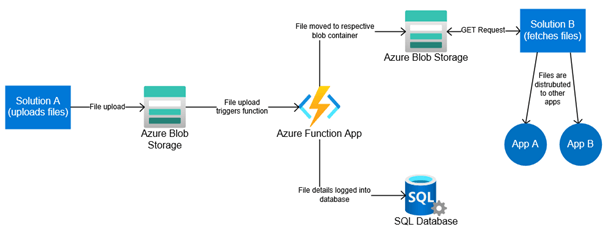
Recently, our team tackled a project that required two large systems to communicate with each other and to handle significant amounts of data. Solution A would collect large data files, and Solution B needed to distribute them. Our goal was to move this data quickly and securely, while also keeping a record of the files in a database for tracking purposes. Here’s how we used Azure Function Apps to do it:
Solution A drops files into an Azure Blob Storage account When a file is uploaded, it triggers an Azure Function App. The Function App moves the files to their proper locations in Blob Storage and logs each file’s details in an Azure SQL database. Solution B (an API) then picks up the files via a GET request to distribute them further to other applications. This entire process happens in real time, making sure data moves quickly and efficiently between the two systems, even when handling large volumes of information.
If you are curious what this looks like in practice , see the diagram

Why this approach works
Using Azure Function Apps allows us to break down complex processes into simple, manageable steps. We can develop and update small pieces of code quickly, which means our team can adapt to changes faster. Plus, since Function Apps scale automatically based on demand, we only pay for what we use—this keeps costs down while ensuring the system can handle traffic spikes. Another key benefit is the seamless integration with other Azure services, like Blob Storage and SQL databases, which lets us manage everything from one platform. This makes it easier to maintain and update our solutions.
Agile teamwork
In Vattenfall’s integration department, we work in Agile teams, where collaboration is at the core of everything we do. We hold regular meetings to assess progress, adjust priorities, and ensure that the solutions we build are truly meeting the needs of the business. The flexibility of Azure Function Apps fits perfectly into our Agile workflow because it allows us to iterate quickly and make improvements without rebuilding entire systems.
This is where the journey ends, I hope you found it interesting and that by now you can understand a bit more of what “integration” means and how we make it happen with the help of technologies like the Azure Function App.


Teaser
General BusinessContent Type
BlogPublish date
09/30/2026
Summary
Meet Athanasia“AI only becomes valuable when it solves real-world problems.” That belief has guided Athanasia Louloudi throughout more than a decade at Vattenfall. From technical specialist to l

Teaser
General BusinessContent Type
BlogPublish date
09/30/2026
Summary
PlaceholderVattenfall engineer Sonsoles Jimenez sees innovation as a collaborative process, where different perspectives, disciplines and expertise come together to solve challenges and prepare
.jpeg)
Teaser
General BusinessContent Type
BlogPublish date
09/30/2026
Summary
Meet TonyFor Vattenfall engineer Tony Sibo the switch between theory and practice creates a variety which makes his work unpredictable and interesting. It helps him see the way to a better tomor

Teaser
General BusinessContent Type
BlogPublish date
09/30/2026
Summary
PlacePhysical hydropower models, drones and digital twins. As the person responsible for model projects at Vattenfall’s laboratory, Pär Nilsen enjoys a varied working day filled with innovation.

Teaser
General BusinessContent Type
BlogPublish date
09/29/2026
Summary
Meet Dado HadziomerovicVattenfall engineer Dado Hadziomerovic believes the journey is just as important as the final solution when it comes to innovation. And if you’re travelling with a team –

Teaser
General BusinessContent Type
NewsPublish date
08/07/2026
Summary
introWhat happens when students, AI and real-world energy challenges come together? That’s exactly what HackoWatt is all about.Together with the University of Silesia, we’re launching an interna


Teaser
E-MobilityContent Type
BlogPublish date
07/23/2026
Summary
Author: Eli SchalkersAt Vattenfall, we continue to explore how artificial intelligence (AI) can be embedded into our operations to support smarter and more flexible energy systems. One example i

Teaser
General BusinessContent Type
BlogPublish date
04/15/2026
Summary
“The fact that I everyday get to contribute to the goal of a fossil free future is so cool. The number of competent women at Vattenfall driving this change is even cooler”There's an endless vari

Teaser
General BusinessContent Type
BlogPublish date
03/16/2026
Summary
ITEMBehind every modern energy system lies a complex network of assets, data, and decisions that need to work together seamlessly. At Vattenfall, one of the projects enabling this transformation

Teaser
General BusinessContent Type
NewsPublish date
12/11/2025
Summary
New office in PolandA major milestone for Vattenfall in Poland: the new office at Grundmanna Office Park in Katowice will serve as the new place of work for almost 500 professionals. St